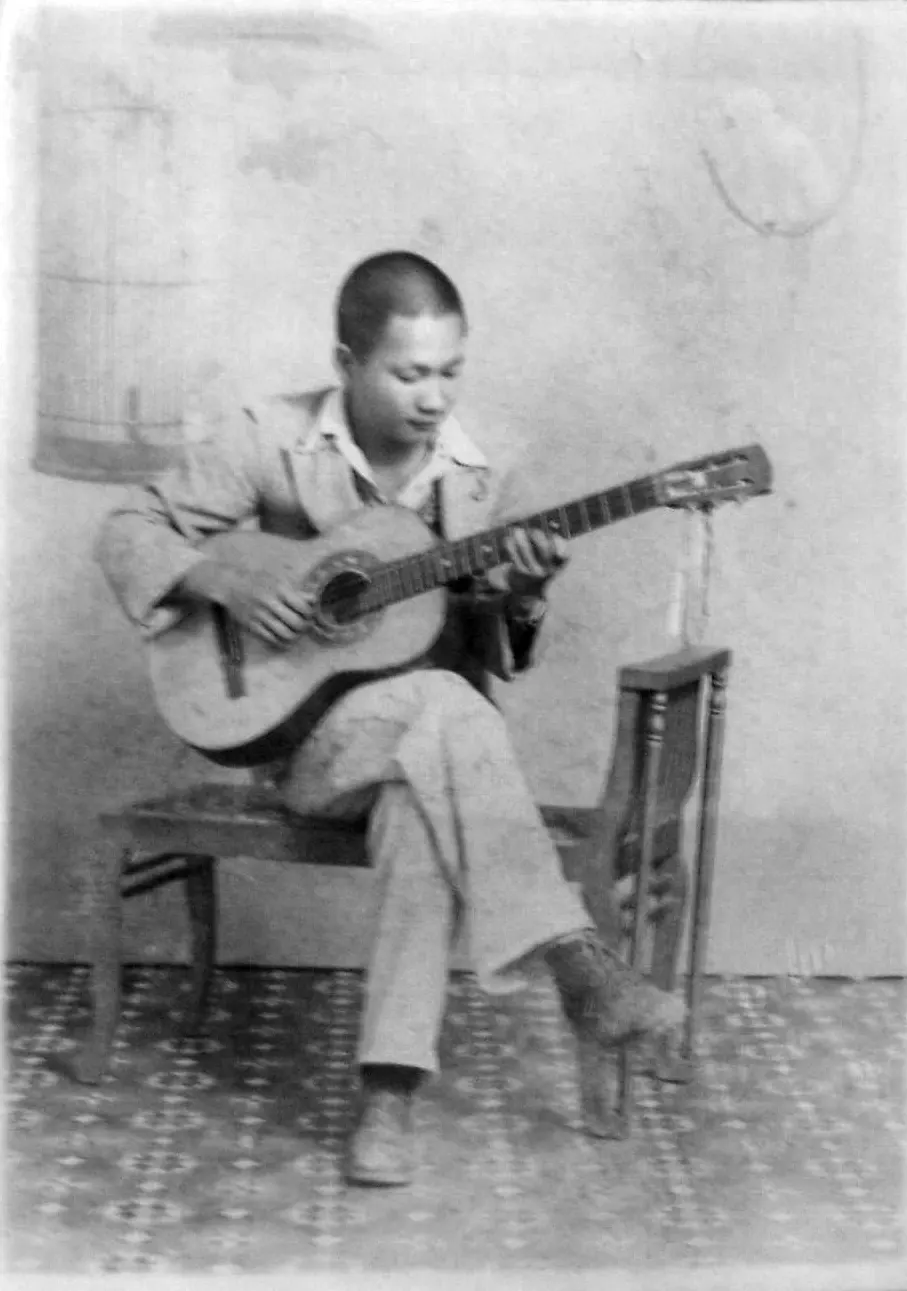
Hu Shu-lin
A pioneer of classical guitar in Taiwan. Born in Taichung during the Japanese colonial period, he devoted his life to teaching the instrument — writing the method, training the students, organising the society and, finally, publishing the magazine almost single-handed, rebuilding Taiwanese guitar music from the ruins of the war.
He taught under the professional name Lin Genjiro (林絃二郎), with the Japanese name Ejima Nobuo; his real name was Hu Shu-lin. So "the Lin Genjiro Guitar Institute" in the family albums was his own studio, and the 198 registration cards are his own students.
Teacher and method books
He studied with the Japanese guitarist Sasaki Hiroshi, whose own teacher was the composer Koga Masao. He taught from the Carcassi method (Matteo Carcassi, 1792–1853) and the Arenas method (Mario Rodriguez Arenas, 1879–1949), and arranged popular songs — including Koga's — so that the classical guitar could also accompany singing, which drew more beginners in.
How he taught
Following the Carcassi method he graded students into four levels: elementary (notation, right- and left-hand fingering, studies in every key), intermediate (technique, intervals, modulation, position studies), advanced (the 50 progressive studies, special tunings, special fingering) and research (the 25 studies, judged only on tone and rhythm, at professional standard). He was strict — a student whose technique or phrasing was not ready might spend two or three lessons on the same piece and still not pass; the piece had to be played through perfectly.
Students and societies
Several hundred students passed through his studio, among them the Taichung county magistrate Lin Ho-nien, Lin Shui-chan, the folk-song arranger Hung Tung and Wu Wu-chang of the Sanxin Bank. As the numbers grew he founded the Taichung Guitar Music Association and held an annual recital; earlier, as deputy leader and coach of the Matsumachi brass band, he had conceived of combining strings and winds, and later founded the Taichung Guitar Light Music Association. Every concert was a charity performance — no tickets were ever sold.
War, silence and rebuilding
When the Sino-Japanese War broke out in 1931 guitar activity in Taiwan was suspended; by the end of the war in 1945 the old scene had dispersed. He set out to revive it, and in 1956 founded Guitar Monthly (吉他月刊), the first guitar magazine in Taiwan — writing the pieces, the articles, the editing and the printing himself.
The last issue
When the eleventh issue appeared in 1957 he was already worn out by overwork and could not travel to Japan for the World Guitar Music Convention; he had arranged for Lu Chao-hsuan to represent Taiwan at the 21st World Guitarists' Convention in Tokyo. He died after repeated treatment for peritonitis — the eleventh issue of Guitar Monthly was his last work. Four years after his death Lu Chao-hsuan won acclaim abroad with "Willow" and "Hometown", which he did not live to see.
Chronology